 Green Legacy Seeds
scarlet firethorn - red firethorn
Pyracantha coccinea

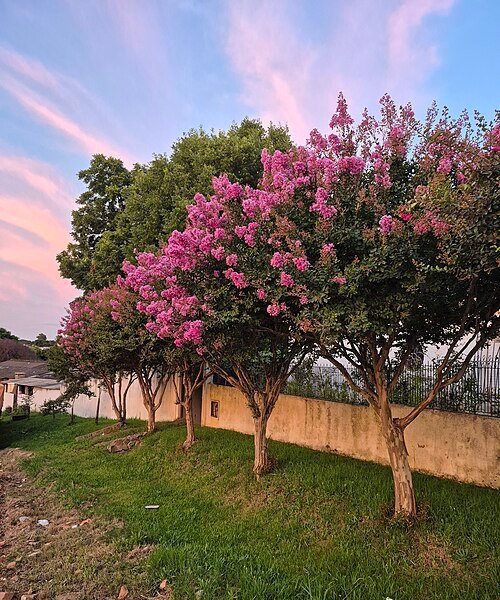
Lagerstroemia indica
India
The Tibetan lofant (Agastache rugosa) has many other names:
Korean mint (belongs to the same family of clearworms);
purple giant hyssop;
blue licorice;
indian mint;
wrinkled giant hyssop;
chinese patchouli;
huo xiang;
lofant Tibetan.
The latter is a tracing paper from another Latin name-Lophantus tibeticus. This name is a synonym of Agastache rugosa.
The Tibetan mulberry tree also grows in Russia in the Primorsky Territory.
Lofant tibet is a perennial herb with a height of 0.4-1 m with quadrangular stems. The leaves are large: 4.5-9 cm long, 2-6 cm wide. The shape can be lanceolate or ovoid. The base of the leaf is heart-shaped. The petiole is 1.5 to 3.5 cm long. The edge of the leaf is notched. The leaf blades are thin. On the upper side, the leaves are dark green, on the lower side-light. The leaf plates are pubescent on both sides.
The flowers are collected in spike-shaped inflorescences, the length of which is up to 10 cm, and the diameter is 2 cm. On the peduncles below, there are also leaves, the same shape as the main ones. But the size of these leaves is smaller.
The flowers are bisexual and capable of self-pollination. There is also pollination by insects. The calyx is long (4-8 mm), colored purple or lilac. The double corolla has a length of 7-10 mm. Flowering lasts from June to September.
There are forms of lofant Tibetan with white, purple and blue flowers. White flowers have a more pungent smell than colored ones.
No reviews yet. Be the first to review!
No questions yet. Ask the first!


