 Green Legacy Seeds
scarlet firethorn - red firethorn
Pyracantha coccinea

Berberis lycium Royle
Himachal Pradesh, India
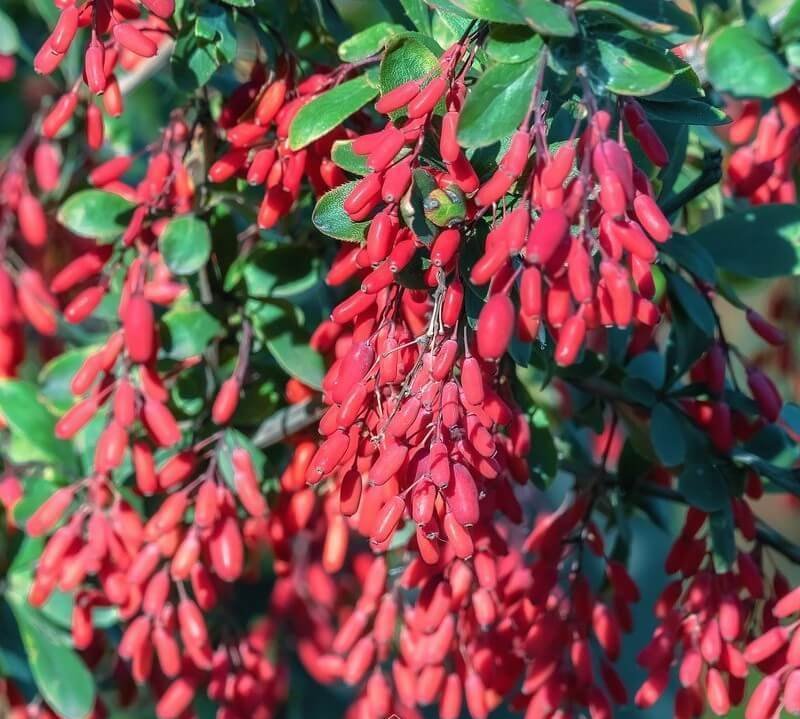
Common barberry (lat. Berberis vulgaris).
Tall (up to 2.5 m), strongly branched, thorny shrub with creeping, woody rhizomes. The bark is light brown on the outside, dark yellow on the inside. The shoots are faceted, erect, yellowish or yellowish-purple, later whitish-gray.
Buds up to 1 mm long, sharp, glabrous, surrounded by dilated remaining leaf sheaths. Normal leaves develop on shortened shoots, and thorns instead of leaves on elongated shoots. The leaves are alternate thin, obovate or elliptic, up to 4 cm long, 2 cm wide, wedge-shaped narrowed towards the base, with a rounded, less often slightly pointed apex, finely and sharply serrated, on short petioles. The spines are three to five, usually three-, less often five-parted, 1-2 cm long.
Racemes are 15-25-flowered, up to 6 cm long. Flowers are yellow, 6-9 mm in diameter. Each flower has six obovate sepals and petals. The raceme consists of 15-25 flowers. At the base of the flower there are bright orange nectaries. One pistil, six stamens, opposite to the petals. The ovary is superior, unilocular with a sessile capitate stigma.
The fruit is a berry, oblong-elliptical, bright red or purple, up to 12 mm long, has a sour taste. Blooms in April - May. The fruits ripen in September - October.
Widely cultivated in gardens and summer cottages. Notable for its beautiful rounded crown shape and massive flowering for almost three weeks. Especially decorative in autumn, in fruits. Suitable for creating difficult-to-pass hedges, including trimmed ones.
Almost any soil is suitable, for example, it grows on clay and loamy soils without much hassle. However, for a good exterior, we recommend that you still prepare a place for it with moisture- and breathable, neutral and nutritious soil, with a drainage layer protecting it from excess moisture.
USDA Hardiness Zone: 3 (-40°C to -34°C).
No reviews yet. Be the first to review!
No questions yet. Ask the first!


