 Green Legacy Seeds
scarlet firethorn - red firethorn
Pyracantha coccinea

Corylus jacquemontii
India
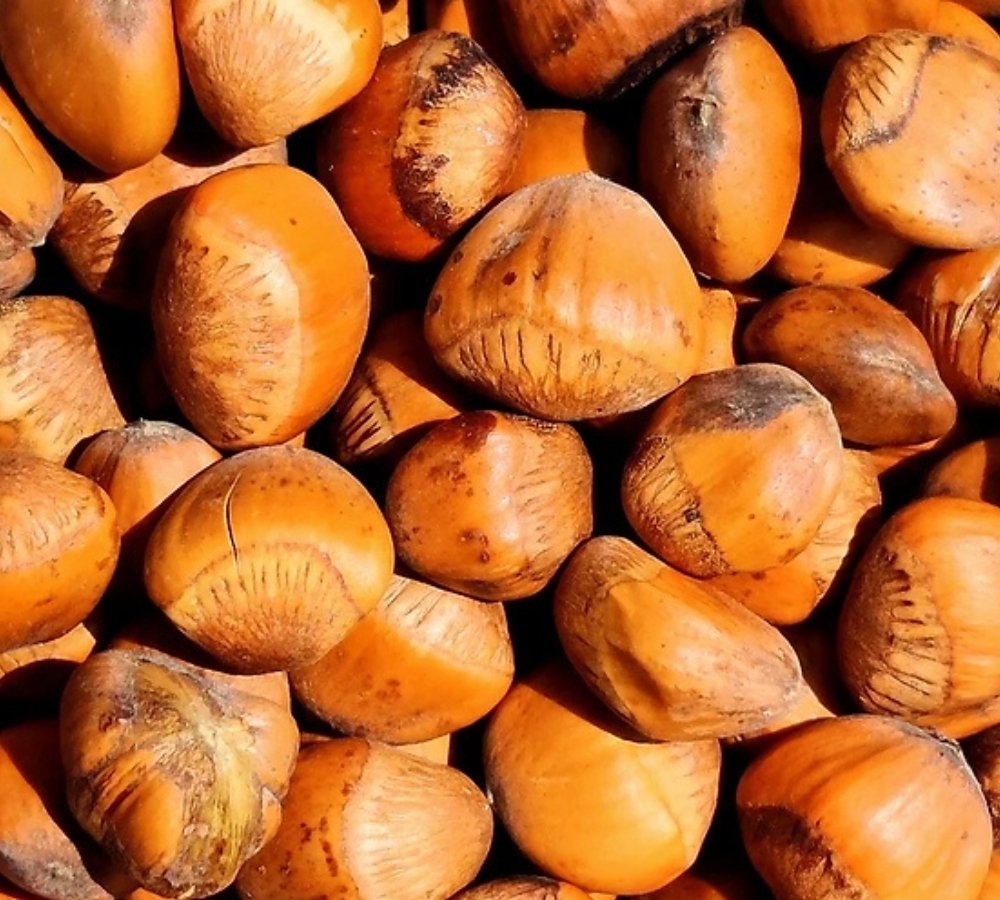
Corylus colurna fresh seeds nuts, Turkish hazel, Hazel seeds, Turkish filbert, Bear nut seeds, Tree hazel nut, Organic seeds, Non GMO (lat. Corylus colurna).
Deciduous tree, a species of the genus Hazel (Corylus) of the Birch family (Betulaceae). Unlike most other types of hazel, this species is not a shrub, but a tree up to 20-30 meters tall, living up to 200 years with a thick-shirokopyramidal crown.
The root system is deep, rod-shaped. The tree-like hazel does not give root offspring. Annual shoots are yellowish-gray, with bristly-hairy pubescence. The bark on the trunk and old branches is gray, deeply fractured, separated by plates. The buds are oblong-ovate, with reddish-brown pubescent scales.
The leaves are rounded, dark green, broadly ovate or oval in shape, 7-12 cm long, 5-9 cm wide. Stipules are lanceolate, pointed. The base of the leaf blade is heart-shaped, it is narrowed to the top, short pointed, the leaf edge is double-toothed. Young leaves are pubescent from above, hairy from below mainly along the veins, later they become glabrous. Petioles 1.5-4.5 cm long, glandularly pubescent.
Blooms early in spring, in March-April. Male flowers are collected in cylindrical catkins 6-10 cm long, up to 6 mm thick. Female flowers are hidden in small buds, from under the scales of which only stigmas are exposed during flowering.
Bear nut fruits are single-seeded nuts, collected together in 3-8 pieces. The nut wrapper (pluska) is glandular, wide-open, its leaves are much longer than the nut itself and are repeatedly dissected into linear-lanceolate sharp segments, often sickle-shaped curved. The nuts are small, squeezed from the sides, with a very thick hard shell. Fruiting is not regular, productive years alternate with 2-3 lean ones. Harvest in August-September.
Although the fruits of the bear nut are small and with a very hard shell (it is impossible to crack it with teeth), their kernels are very tasty.
No reviews yet. Be the first to review!
No questions yet. Ask the first!


