 Green Legacy Seeds
D
Duchesnea, Mock strawberry, Indian-strawberry
Potentilla indica

Rubus idaeus
Eurasia
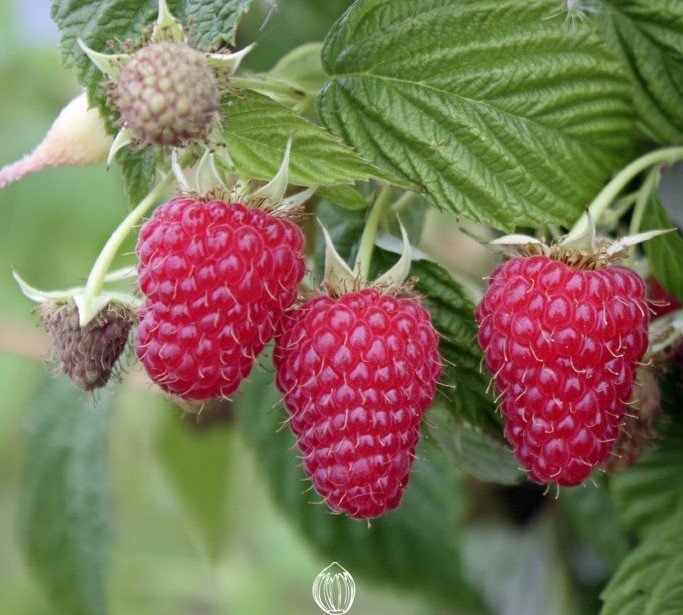
Red garden raspberry, or common raspberry (lat. Rubus idaeus).
Subshrub, species of the genus Rubus of the Rosaceae family. Deciduous subshrub with a perennial rhizome, from which biennial aboveground stems develop, 1.5–2.5 m high.
The rhizome is sinuous, woody, with multiple adventitious roots, forming a powerful branched system.
Stems are erect. The shoots of the first year are herbaceous, green with a bluish bloom, juicy, covered with thin, usually frequent miniature thorns. In the second year, the shoots become woody and turn brown; they dry out immediately after fruiting, but new stems grow from the same root the next year.
The leaves are oval, alternate, petiolate, compound, with 3-7 ovate leaflets, dark green above, whitish below, pubescent with small hairs.
The flowers are white, about 1 cm in diameter, collected in small racemes, located on the tops of the stems or in the axils of the leaves. The petals are shorter than the calyx lobes. It blooms from June to July, sometimes until August.
The fruits are hairy drupes fused on the receptacle into a complex fruit. The fruits are red. Fruits usually appear in the second year. In the first year, two flower buds are formed on the replacement shoots in the leaf axils, from which fruit branches grow in the second year. In the southern regions, fruits also appear on the shoots of the first year in mid-autumn.
Honey plant. Due to the fact that the raspberry flower is tilted down, the bee extracting nectar is as if under a natural canopy and can work even during light, warm rain.
It can grow in poor soil, but for abundant fruiting it needs fertile soil, preferably loamy soil.
USDA Hardiness Zone: 4 (-34°C to -29°C).
No reviews yet. Be the first to review!
No questions yet. Ask the first!


