 Green Legacy Seeds
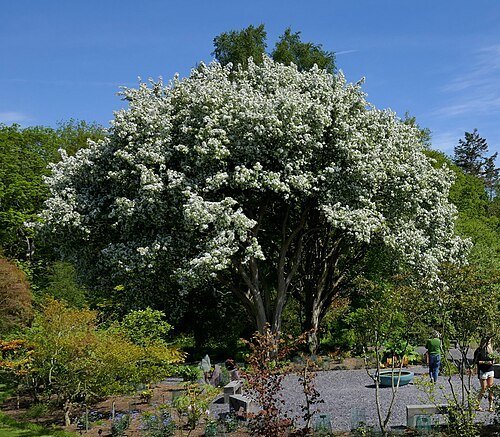
mountain hawthorn - Chinese haw - Chinese hawthorn
Crataegus pinnatifida

Malus hupehensis
South Korea
Xanthoceras sorbifolium fresh seeds, Yellowhorn, Shiny leaf yellowhorn, Goldenhorn, Chinese flowering chestnut, Peanuts tree, Organic (lat. Xanthoceras sorbifolium).
A monotypic genus of deciduous trees, part of the Sapindaceae family. The only species is Xanthoceras sorbifolium.
Deciduous tree up to 8 m high with a dense pyramidal crown. The branches are quite thick, erect, and softly hairy when young.
Leaves are alternate, without stipules, imparipinnate, with 9–17 leaflets, 20–25 cm long. Leaflets are sessile, usually opposite, sometimes alternate, lanceolate, 3–5 cm long, 0.7–1.2 cm wide, sharply serrate, leathery , dark green above, light below.
The inflorescence is a dense, multi-flowered raceme, 15-25 cm long, located at the ends of the shoots and shortened lateral branches. The flowers are white, regular, bisexual and staminate, up to 4 cm in diameter, on pedicels about 1.5 cm long.
The fruit is a triangular-ovoid or elliptical capsule, up to 5 cm in diameter. Seeds are up to 1.8 cm long, 1.5 cm in diameter, edible.
One of the most beautiful ornamental plants, valuable for its abundant flowering and beautiful bright greenery that lasts until late autumn.
Does not tolerate stagnation of water, especially at a young age. Prefers good loamy soil, but does well in most well-drained fertile substrates in a sunny position. Loves a warm, dry environment and requires protection from cold winds.
USDA Hardiness Zone: 4 (-34°C to -29°C).
No reviews yet. Be the first to review!
No questions yet. Ask the first!


