 Green Legacy Seeds
mountain hawthorn - Chinese haw - Chinese hawthorn
Crataegus pinnatifida

Morus nigra
South Korea
Mulberry Nigra (Latin Morus nigra).
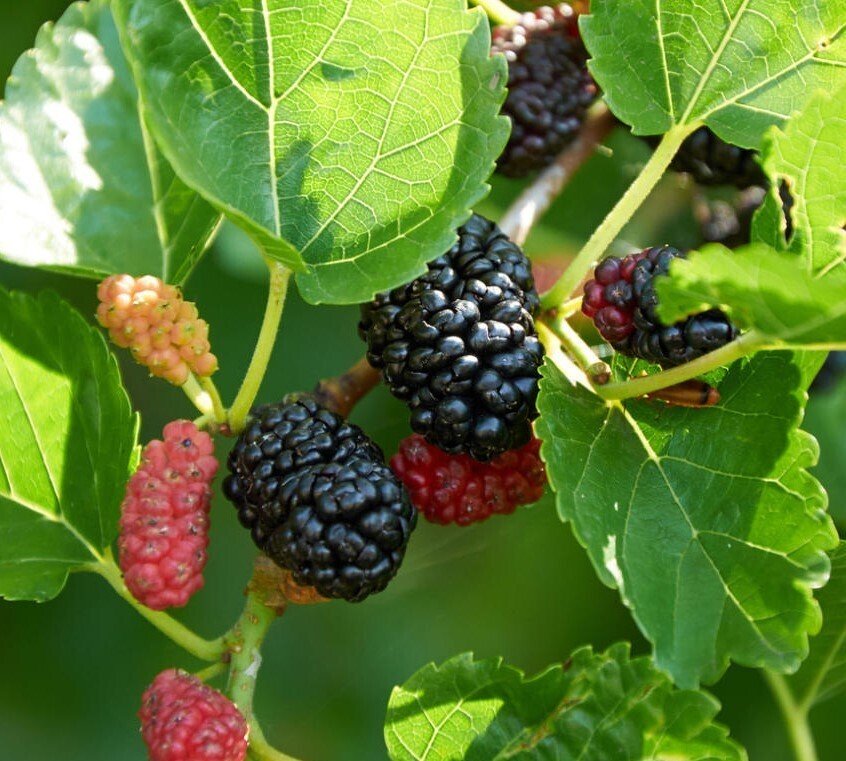
Black Mulberry (Nigra). Mulberry tree, mulberry, mulberry. The tree is 15-20 m tall, in unfavorable conditions - a shrub up to 3 m. The crown is thick, spherical. The leaves are large, dark green in summer, straw-yellow in autumn. It has edible very sweet, delicious and decorative blue-black color coplodia.
Mulberry is light-loving, unpretentious to the soil. Tolerates pruning well. It is quite frost-resistant, withstands a temperature drop to -30 ° C. Black mulberry is native to Iran and Afghanistan. Plants are less tall plants (up to 12 meters), otherwise the biological features are similar to white mulberry, but black is less hardy and drought-resistant, which, apparently, is the limiting factor of its wide distribution.
The fruits have a black-purple color, a sweet-sour taste, juicy, very tasty flesh with a pleasant slightly coloring juice.
Deciduous tree with a dense broad-pyramidal crown. The flowers are bisexual, collected in ears. The leaves are simple 3-5 lobed. Coplodium is an edible, juicy, sugary complex drupe ("mulberry berry") of white color with a size of 3.0 cm, a diameter of 1.0 cm.
The taste is honey-sweet without aroma. Fruiting is abundant and regular; the berries ripen in June-July. The yield is good.
The variety is unpretentious to the soil and to the conditions of maintenance. Winter hardiness - zone 4.
No reviews yet. Be the first to review!
No questions yet. Ask the first!


