 Green Legacy Seeds
mountain hawthorn - Chinese haw - Chinese hawthorn
Crataegus pinnatifida

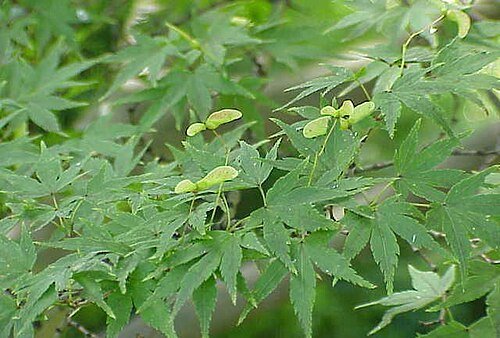
Acer palmatum subsp. 'Amoenum'
South Korea
Cryptomeria japonica, or "Japanese cypress", in Japanese "sugi", in Chinese "Shan", "red Japanese cedar" (Cryptomeria japonica) is a coniferous evergreen forest – forming tree with a height of up to 60 m, with a trunk thickness of up to 2 m, the only species of its genus.
The bark is fibrous. Red-brown color. Over time, it peels off and gradually falls off. The shoots form a conical crown.
Scales on small buds are absent. The triangular needles have a needle-like structure. In length, it rarely exceeds 25 mm. It feels soft to the touch. The location of the needles is spiral. Only 5 rows. Each needle is bent inwards and slightly curved.
The life span of the needles is up to 7 years. The color is different and depends on the season. In summer-light and dark green, in winter the color changes to brown.
The plant is monoecious. The flowers are formed at the very tips of the shoots. The color in both cases is yellow. It is very rare to meet bunches of 2-3 flowers, since single ones grow more often. the cones are not large in size.
Rarely exceed 2 cm. Their color is brown. The shape is spherical. The scales are maple-shaped and lignified. They do not leave their places even after full opening and further dispersal of the seeds.
The life span of coniferous Cryptomeria reaches 1000 years. Some instances live much longer. The Japanese made the culture in the state register of values, as the plant is considered a national symbol.
No reviews yet. Be the first to review!
No questions yet. Ask the first!


