 Green Legacy Seeds
Butternut squash
Cucurbita moschata

Ricinus communis
India
This product is currently out of stock. Leave your email and we'll notify you when it's back.
Castor beans, Castor oil plant, Ricinus plant red giant (Lat. Ricinus, Ricinus communis)
In tropical and subtropical areas , castor is an evergreen shrub up to 10 m high . In the conditions of culture in temperate countries (Russia and others), it is an annual plant up to 2-5 m tall.
The stems are erect, branched, hollow inside, pink, red, purple or almost black, covered with a bluish waxy coating.
The leaves are large, 30-80 cm long, deeply cut, sometimes separate, pointed, unequally toothed, dull green with petioles 20-60 cm long.
In summer, racemose terminal or axillary inflorescences of green with a red tint of flowers appear. Castor is a monoecious plant: male and female flowers are located on the same plant; male in the lower, and female in the upper part of the inflorescence axis. The flowers are small, light cream or white. Stamens are numerous, collected in branched bundles. Pistils with a three-part column and fringed stigmas are red, crimson or light yellow.
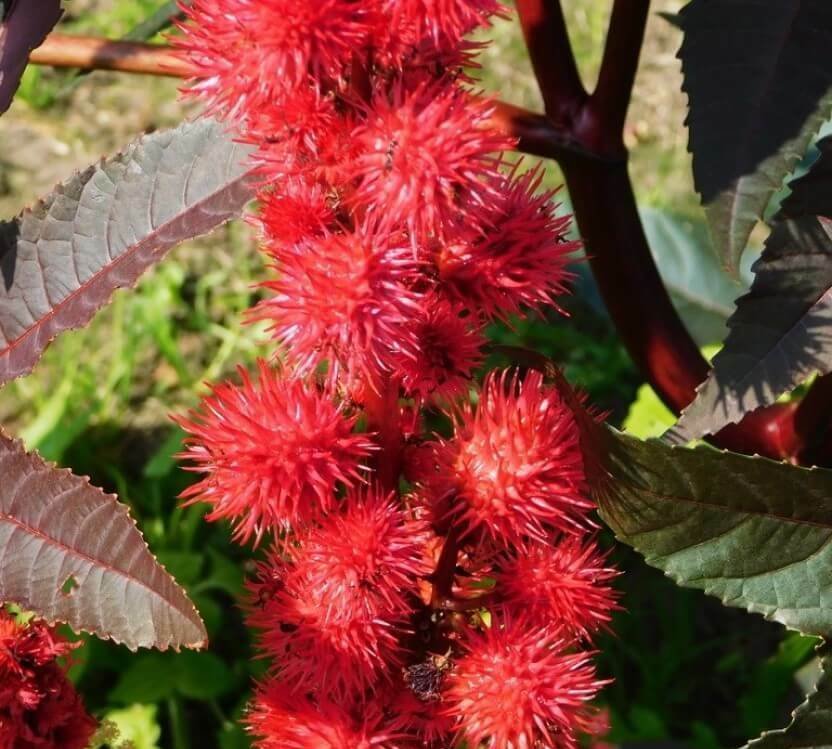
The fruit is a spherical naked or prickly capsule up to 3 cm in diameter. Located between the leaves, the fruits give the plant a decorative appearance.
Mature seeds have an oval shape. On the dorsal side they are convex, on the abdominal side they are flatter, there is a longitudinal seam in the middle. The seed shell is smooth, shiny, variegated, mosaic. Depending on the castor variety, the mosaic can be brown, pink, light pink, contrasting against the background of the seed. The background color varies from gray to copper-red. Thus, the seed resembles a tick in its shape and mottled color, hence the corresponding name of the plant. At the top of the seed there is a seedling, easily falling off and having the appearance of a white appendage.
No reviews yet. Be the first to review!
No questions yet. Ask the first!

